Lesson-matched assignments
Every Young Minds lesson has its own digital assignment: six focused questions and five practical board activities that help a learner apply the lesson.
Learning beyond the lesson
Explore the academy's chess books and Young Minds learning materials, with practical support for students and the adults helping them learn.
 Begin with the board. Build from there.
Young Minds
The curriculum follows 52 lessons across four levels, moving from first encounters with the board toward more developed chess thinking.
Large boards, simple explanations, and focused activities help young learners put each lesson into practice.
Ask about academy learning materials ↗Published curriculum book
A complete instructional guide for students, parents, and instructors. The published book brings the academy's 52-lesson pathway into homes, classrooms, clubs, and community programs.
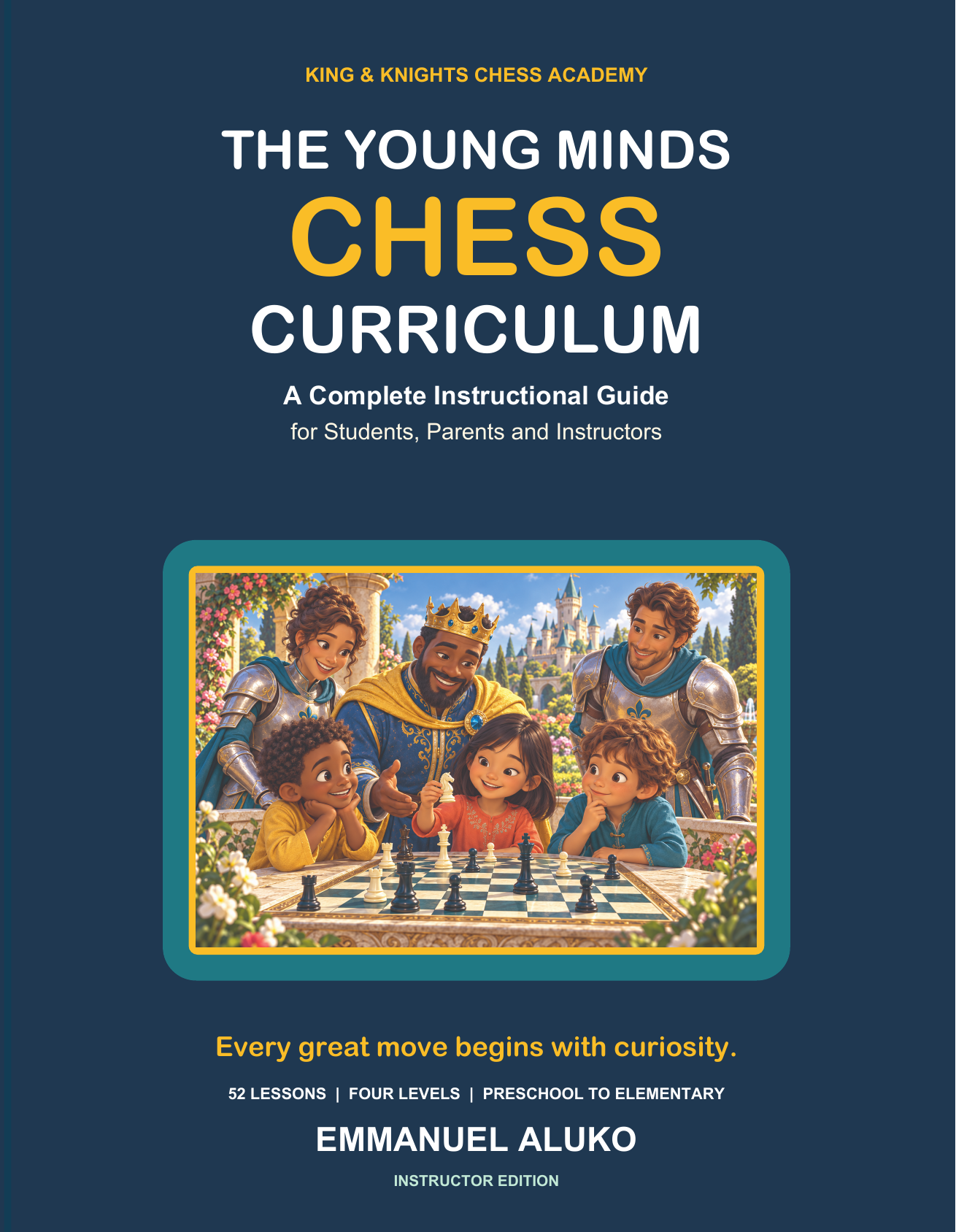 Available in paperback and Kindle editions.
Also by Emmanuel Aluko
A Complete Instructional Curriculum for Students and Instructors
A structured introduction to chess for beginner learners and the people teaching them, with clear diagrams, practice activities, and progressive lessons.
Support at every step
Every Young Minds lesson has its own digital assignment: six focused questions and five practical board activities that help a learner apply the lesson.
Plain-language guidance helps guardians understand the process and encourage a child without needing to teach the answers or already know chess.
A separate marking guide supports consistent review. The instructor considers practical work and accepted alternatives before approving the official score and feedback.
Class assignments and support materials are supplied through the academy. Submission timing is set for the learner's actual class or group rather than by one fixed schedule. The published book is available separately in paperback and Kindle editions.
The K&KCA learning difference
Learners can meet an idea, practise it, show what they understand, and receive feedback that points to the next useful step.
Play the computer, share one board, or challenge another visitor online with a chess clock. The free Chess Lab needs no account.
Open the free Chess Lab ↗Each of the 52 Young Minds lessons connects to a matching assignment, so practice follows the idea taught rather than becoming unrelated busywork.
Technology can organize answers and propose marks, but an instructor reviews the work and approves the official score and guardian feedback.
Clear expectations: Free Chess Lab play is for practice and enjoyment, not a formal chess rating or guaranteed assessment. Visitor challenges are anonymous and separate from Academy student work. Learning outcomes vary with attendance, participation, and practice.
What guardians can expect
The process is designed to be practical for families while keeping the instructor responsible for the final learning judgment.
The academy provides the assignment for the correct lesson with an opaque Academy learner code. The learner is not asked to enter a name, school, birth date, address, email, or telephone number in the assignment.
Depending on the lesson and agreed format, work can be completed digitally or on paper and returned manually by the guardian. No special parent knowledge is required.
The academy reviews the work locally, approves the official result, and prepares clear guardian feedback. Questions or a possible marking error can be raised for a documented correction.
Before use: The academy explains the assignment process and obtains affirmative guardian consent. Technology-assisted marking may propose a result, but uncertain drawings, explanations, board markings, and accepted alternatives require instructor review. Scores describe the submitted work and do not guarantee future chess, school, or competition outcomes.
From page to play
Meet the pieces in the free Chess Lab, play the computer, or join an open visitor challenge. A few moves can make a lesson memorable.
Your next move
Tell us a little about your learner. We’ll help you choose a program.