Chess Explorers
Approx. ages 3–4 · 10 lessons
Discover the board and pieces through short, supported play.
King & Knights Chess Academy presents
A complete instructional guide that helps students, parents, and instructors move from the first square to thoughtful play through 52 carefully sequenced lessons.
Instructor edition with student activity pages · By Emmanuel Aluko
A developmental approach
Children do more than memorize how pieces move. They learn to notice, choose, explain, take turns, persist, and reflect—habits that grow through guided play and purposeful practice.
Meet each idea through a clear explanation and a large, readable board.
Explore the position, answer focused questions, and test the idea in play.
Explain the decision, learn from the result, and carry the thinking forward.
One pathway, flexible entry points
Age ranges are guides, not placement tests. Learners can begin where their current understanding and confidence fit best.
Approx. ages 3–4 · 10 lessons
Discover the board and pieces through short, supported play.
Approx. ages 4–6 · 12 lessons
Build secure rules and habits for complete games.
Approx. ages 6–8 · 14 lessons
Recognize patterns, calculate replies, and explain decisions.
Approx. ages 8–11 · 16 lessons
Compare candidate moves, form plans, and review games.
Inside the curriculum
Every lesson combines an inviting illustrated opening with teaching guidance, hands-on exploration, practice, purposeful play, and evidence of learning.
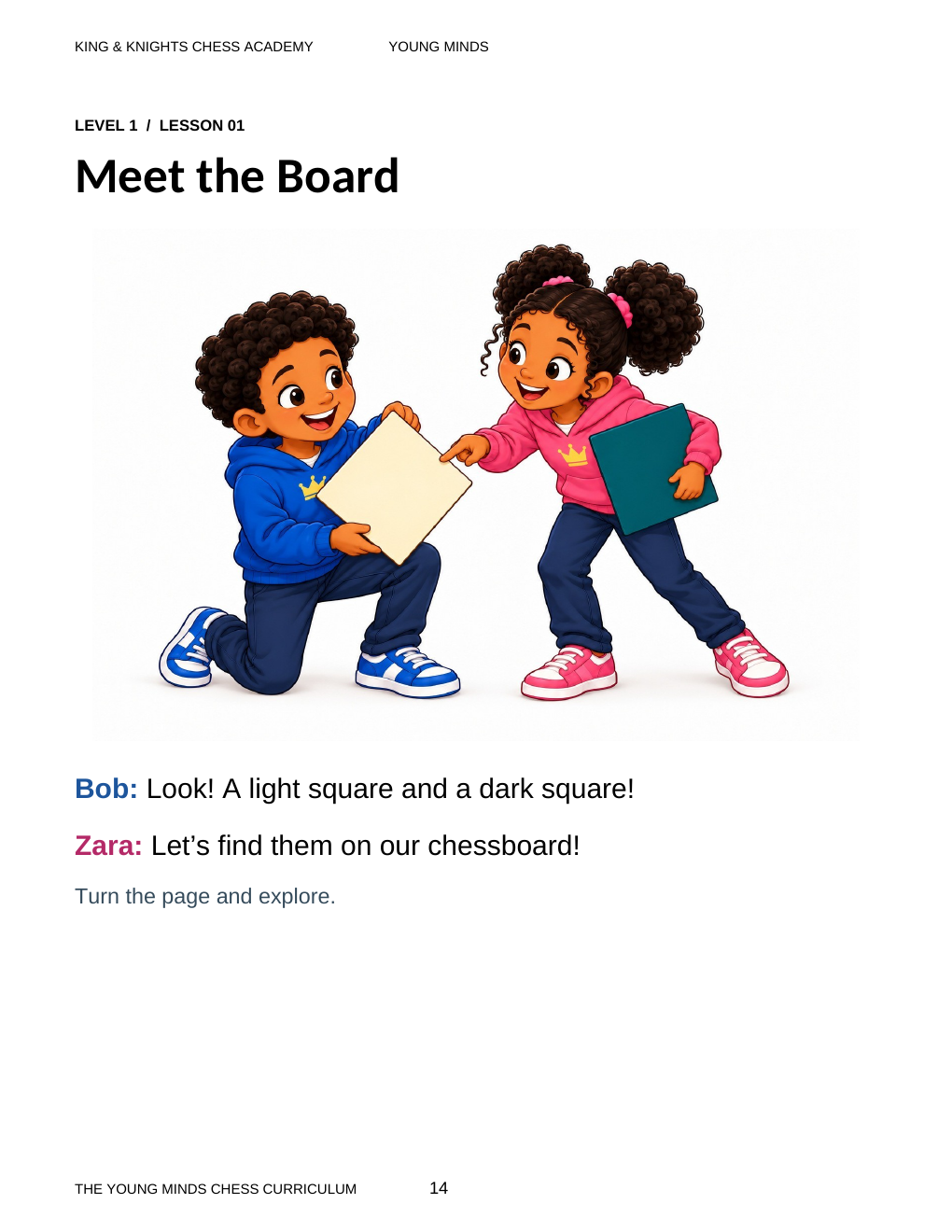
Learn light and dark squares, corners, and how to orient the board correctly.
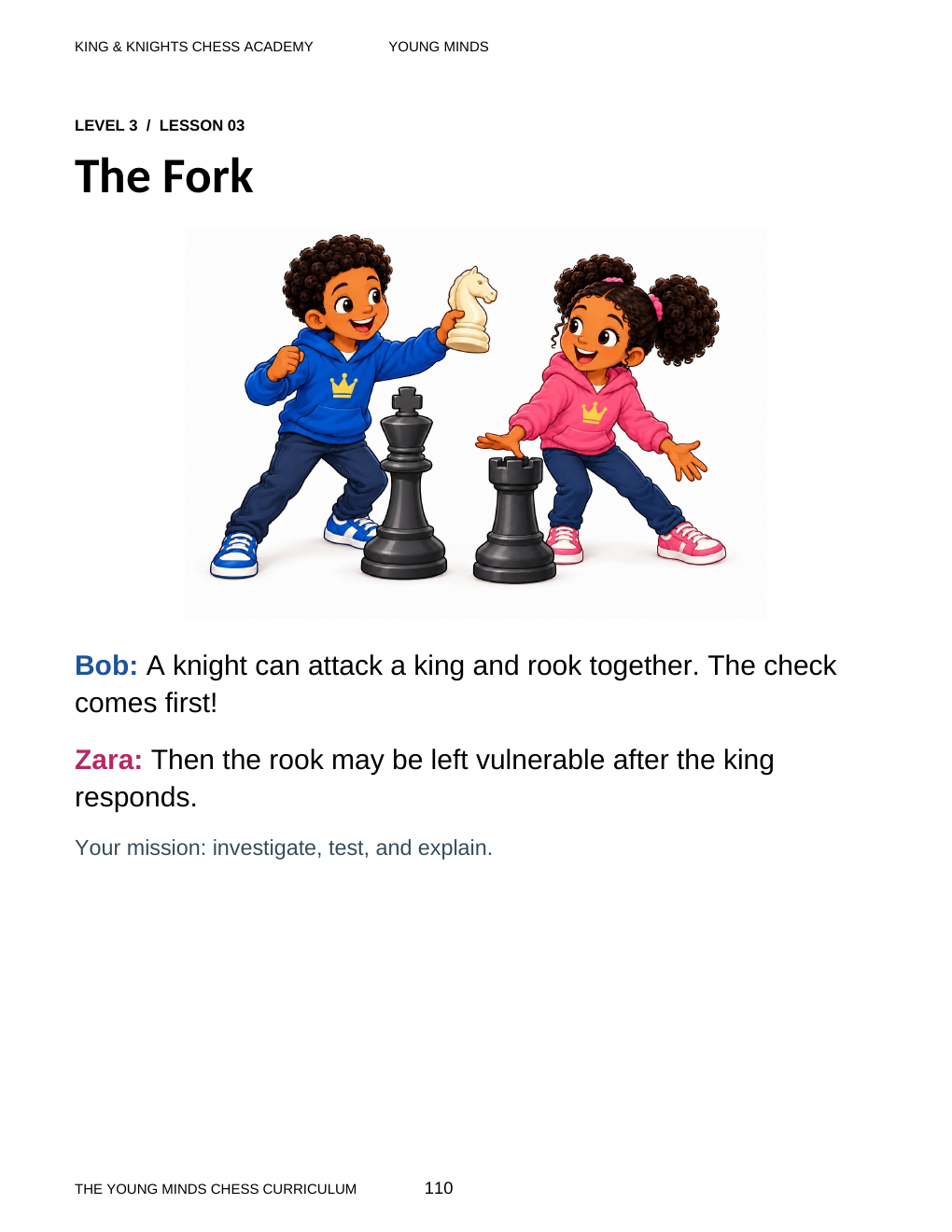
See how one piece can create two threats and learn which threat comes first.
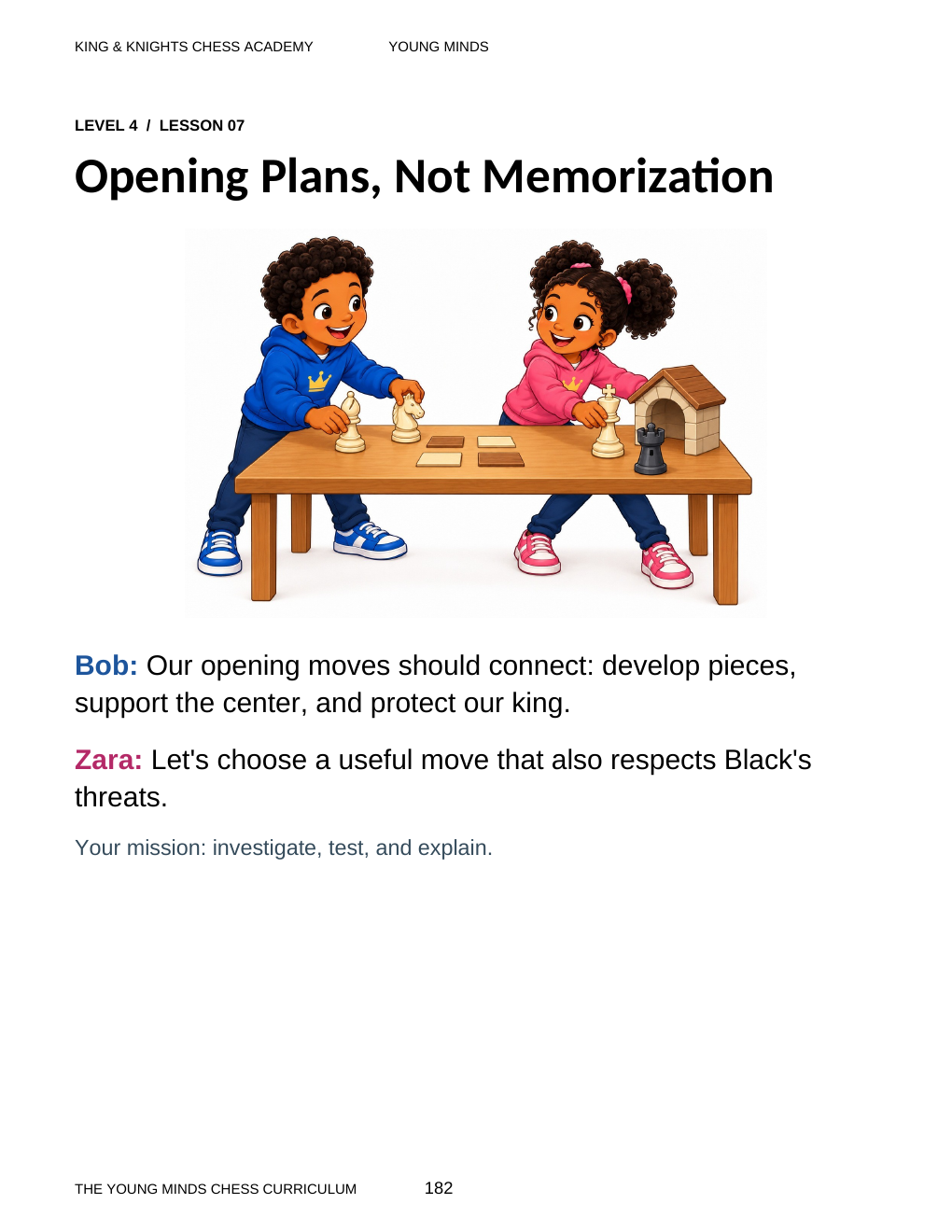
Connect useful moves through development, central support, and king safety.
Made to be used
Plain-language guidance makes it possible to encourage learning even when the adult is new to chess.
Ready-to-use lesson objectives, board setups, activities, answers, and extensions support confident teaching.
A coherent sequence helps enrichment programs move beyond disconnected activities and one-off worksheets.
Flexible entry points support mixed experience levels in libraries, clubs, homeschool groups, and youth programs.
For schools and learning programs
Use the curriculum as an instructor guide, a staff-development resource, or the foundation for a complete youth chess program.
About the author and academy
Emmanuel Aluko is the founder of King & Knights Chess Academy in Maryland. The academy helps learners build chess understanding through clear instruction, purposeful practice, and thoughtful reflection—one move at a time.
Meet King & Knights Chess AcademyBeyond the book
The book is one way to learn with King & Knights. Explore live teaching and other resources for learners, families, and educators.
Bring a lesson to life in the free Academy Chess Lab: try a computer game, practise a skill, or challenge another visitor without an account.
Individual lessons shaped around the learner's pace and goals.
Explore private lessonsBring structured chess enrichment to your school or community.
Explore school programsSee the activities and guidance that support learning between lessons.
Explore resourcesGood questions
No. The curriculum begins with the board and pieces, then develops rules, tactics, planning, and reflection step by step.
Yes. Explanations, answers, setups, and teaching notes are written to help adults guide learning clearly. A real board and pieces are recommended for practice.
No. It is designed for instructors, parents, schools, chess clubs, homeschool groups, libraries, and community programs.
The paperback is the full-color instructor edition with physical activity pages. The Kindle edition offers the same curriculum in a reflowable digital format for compatible devices and apps.
The original purchaser may reproduce the specifically designated activity pages for students directly participating in that purchaser’s classes at one physical location. The full license appears inside the book.
Every great move begins with curiosity
Choose the full-color paperback for hands-on teaching or the Kindle edition for digital access.